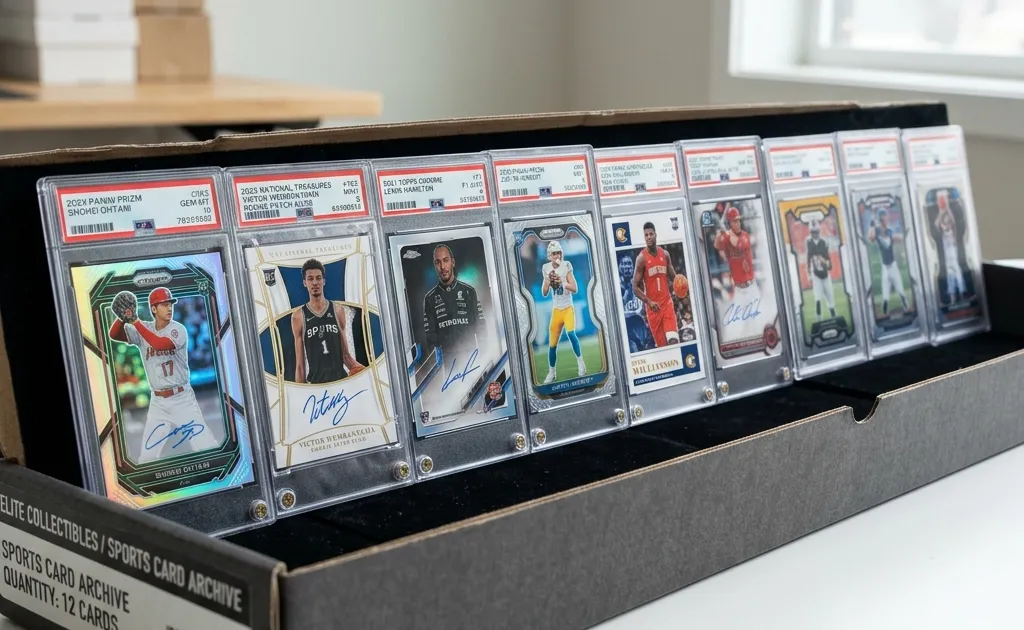
Whether you collect modern rookie cards or vintage legends, one of the most critical aspects of the hobby is knowing how to store sports cards correctly.
A card’s condition is the single most important factor determining its market value. A single scratched surface, bent corner, or chipped edge can instantly cut a card’s value by 50% or more.
In this guide, we will cover the best sports card storage supplies, layered protection systems, and environmental controls to ensure your collection remains pristine for years.
1. The Core Supplies: Penny Sleeves vs. Toploaders vs. Binders
When it comes to sports card protection, different tiers of cards require different storage methods. Here is a breakdown of the essential supplies every collector needs.
Penny Sleeves (Soft Sleeves)
The absolute baseline of protection. Penny sleeves are soft, clear plastic pouches that protect the card’s surface from scratches, dust, and fingerprint oils.
- Best Practice: Every single card in your collection that is worth more than a few cents should be placed in a penny sleeve.
- Tip: When inserting a card, gently pinch one corner of the sleeve to open it up. This prevents the card’s corners from catching and dinging on the edges of the plastic.
Toploaders (Rigid Holders)
Toploaders are rigid plastic shields that prevent cards from bending or sustaining corner damage.
- Best Practice: Slide your card into a penny sleeve first, then insert the sleeved card into a toploader. Never insert a raw card directly into a toploader, as the hard plastic can scratch the surface.
- Tip: Do not force a card into a toploader. If it’s tight, you may need a thicker point size (more on that below).
Magnetic One-Touch Holders
The premium standard for raw cards. These consist of two hard plastic halves held together by a small magnet at the top, with a recessed cutout specifically sized for the card.
- Best Practice: Ideal for your most valuable raw cards (rookie cards, autographs, and low-numbered parallels).
- Tip: Make sure to buy UV-resistant one-touches to prevent the card ink from fading over time.
Binders & Pocket Pages
Perfect for set builders and low-value cards you want to flip through easily.
- Best Practice: Use side-loading pocket pages instead of top-loading ones. Side-loading pockets prevent cards from sliding out when the binder is moved or turned upside down.
2. Environmental Factors: The Silent Killers
Even in hard plastic holders, cards can still degrade if stored in the wrong environment. Three primary elements can ruin your cards silently:
- Humidity: High humidity causes cardstock to warp, bow, or become sticky (often called “greasing” or “bricking” on chrome cards). Keep your cards in an environment with 40% to 50% relative humidity.
- Temperature: Avoid dramatic temperature swings. Do not store cards in attics, garages, or basements. Keep them in a temperature-controlled room (around 65°F to 72°F).
- UV Light: Sunlight is the enemy of sports cards. Direct sunlight will fade the vibrant inks on the front of your cards and yellow the plastic of your toploaders. Always store your boxes out of direct light.
3. Organizing and Boxing Your Collection
Once your cards are sleeved and loaded, they should be stored in boxes designed specifically for sports cards.
- Cardboard Storage Boxes: Classic white cardboard boxes (single row, 2-row, or 4-row “monster” boxes) are cheap and highly effective.
- Horizontal Storage: Always store your cards standing upright (vertical) rather than stacked flat on top of one another. Stacking cards flat creates downward pressure, which can warp cards at the bottom of the stack or cause them to stick together.
- Fill the Gaps: If a row isn’t full, use foam blocks or cardboard dividers to fill the empty space. This prevents the cards from sliding, tilting, and banging against the walls when the box is moved.
How to Inventory Your Newly Protected Collection
Once you have organized and stored your cards in sleeves and cases, the next challenge is keeping track of what you own and how much it is worth.
Instead of writing everything down in a manual spreadsheet that goes out of date the minute a player gets traded, use a digital card collection tracker.
The Sports Card Scanner & Value app lets you quickly catalog your collection:
- Scan in Seconds: Point your camera at your sleeved or graded card.
- Instant Cataloging: Organize your cards into custom digital binders (e.g., “Personal Collection”, “To Trade”, “Graded Cards”).
- Automatic Appraisals: The app tracks live market sales, updating your collection’s value automatically.
Download the Sports Card Scanner & Value app on the App Store or Google Play Store to manage your newly protected collection today!
Get Instant Sports Card Values
Download the Sports Card Scanner & Value app to instantly identify, catalog, and track your baseball, basketball, and football cards using your phone camera.