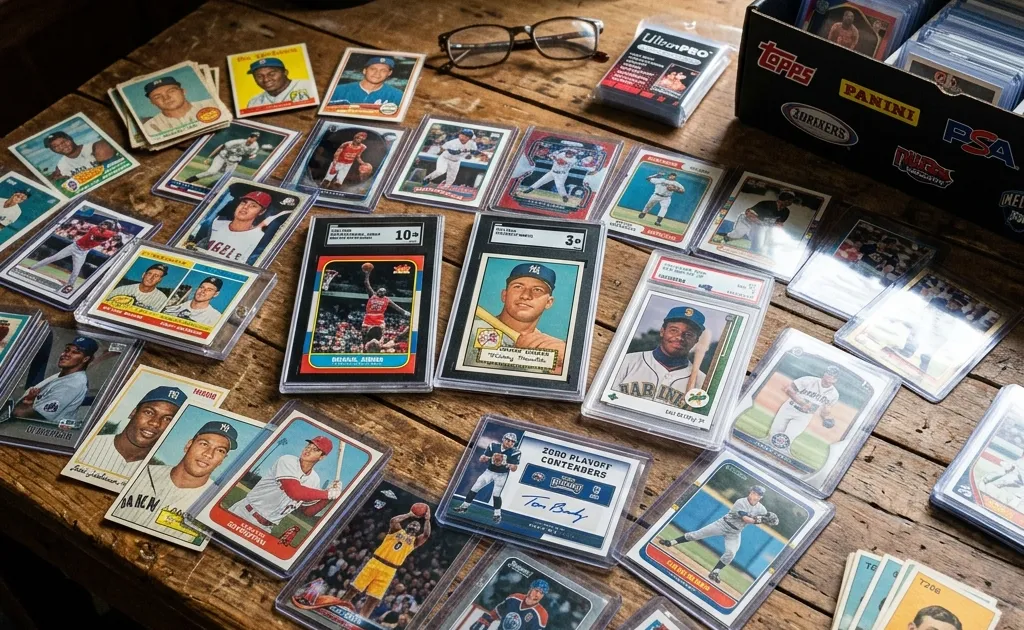
Whether you recently uncovered a dusty shoebox of vintage baseball cards in your attic or you are actively looking to buy and flip modern basketball cards, one question always comes first: What is my sports card value?
Determining the exact market value of a sports card can feel overwhelming. With thousands of players, sets, variants, parallels, and print runs, a card that looks identical to a $500 gem might actually be worth less than a dollar.
In this comprehensive guide, we will break down the exact step-by-step process used by professional collectors to determine sports card value, verify authenticity, and check market comps.
1. Identify the Core Details of the Card
Before you can lookup any prices, you must know exactly what card you have. Look for the following four key pieces of information on the card:
- Year: Usually printed on the back of the card in the copyright line (e.g., © 2021 Panini).
- Player Name: Clearly displayed on the front.
- Brand & Set: Look for logo marks like Topps, Panini, Bowman, Fleer, or Upper Deck.
- Card Number: Located on the back of the card, usually in one of the top corners (e.g., Card #253 or #US250).
Look Out for Parallel Variations
Modern cards are famous for having “parallels” — variations of the base card with different colored borders, foil patterns, or reflective finishes (refractors).
Some parallels are serial-numbered (e.g., 05/99 stamped in gold foil). If your card has a serial number, it means only 99 copies of that exact variation exist, which significantly boosts its potential value.
2. Check Real Market Comps (Not List Prices)
A common mistake beginners make is searching for their card on eBay and looking at the active “Buy It Now” listings. This is not the card’s value. Anyone can list a $1 card for $10,000.
Instead, you must check completed and sold listings to see what buyers have actually paid recently.
How to Check eBay Sold Listings Manually:
- Go to eBay.com.
- Type in the player, year, set, and card number (e.g., “2019 Panini Prizm Zion Williamson #248”).
- On desktop, scroll down the left sidebar filter and check “Sold Items” (which automatically selects “Completed Items”).
- On mobile, tap “Filter” -> “Show More” -> toggle on “Sold Items”.
This list will show you the exact prices cards have sold for over the last 90 days. Calculate an average of the last 3 to 5 sales to get a realistic estimate of the current market value.
3. Understand the Impact of Professional Grading (PSA, BGS, SGC)
If you see two identical cards, but one is selling for $10 and the other for $1,000, the difference is almost certainly professional grading.
Third-party grading services like PSA (Professional Sports Authenticator), BGS (Beckett Grading Services), and SGC (Sportscard Guaranty Company) assess a card’s condition on a scale from 1 (Poor) to 10 (Gem Mint).
- Centering: Is the card perfectly aligned, or are the borders thicker on one side?
- Corners: Are the corners sharp and pointed, or rounded and frayed?
- Edges: Are the edges clean, or is there chipping and silvering?
- Surface: Are there scratches, dimples, stains, or print lines?
A PSA 10 Gem Mint card can command a massive premium over a “raw” (ungraded) card. For example, a raw rookie card might be worth $20, but a PSA 10 copy of the same card could sell for $250+. Conversely, if a card grades as a PSA 7 or 8, it might be worth less than the cost of the grading service itself.
4. Keep Track of Market Value Trends
Sports card values fluctuate constantly based on real-world player performance, injuries, trades, and seasonal hype.
- Pre-season Hype: Card values often spike right before the season starts.
- Playoff Runs: Players on teams making deep playoff runs see high demand.
- Off-season Slump: Prices generally cool down during the sport’s off-season.
If you are building a collection, tracking all these fluctuations manually is nearly impossible.
The Easiest Way to Value Your Cards: Use a Card Valuation App
Checking individual eBay listings, distinguishing parallels, and tracking prices manually takes hours. That is why modern collectors use dedicated technology.
With the Sports Card Scanner & Value app, you can bypass manual searches entirely:
- Instant Scan: Point your phone camera at any sports card.
- Automated Identification: The app’s AI instantly identifies the player, year, set, and parallel variation.
- Real-Time Comps: Instantly see current market estimates, active listings, and historical eBay sold comps.
- Graded Price Data: View PSA, BGS, and SGC graded prices for the card.
Download the Sports Card Scanner & Value app today on the App Store or Google Play Store to value and organize your entire collection in minutes!
Get Instant Sports Card Values
Download the Sports Card Scanner & Value app to instantly identify, catalog, and track your baseball, basketball, and football cards using your phone camera.