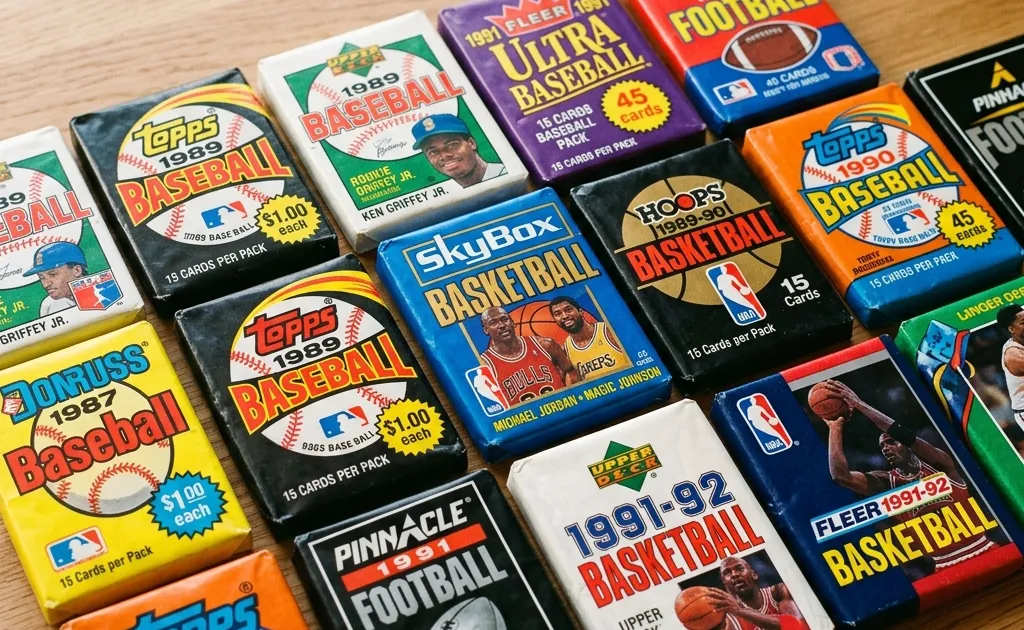
If you grew up collecting cards in the late 1980s or early 1990s, you probably remember the excitement of tearing open packs of Topps, Donruss, Fleer, and Upper Deck. Many collectors tucked those cards away in binders or shoeboxes, believing they would eventually pay for college, a house, or a comfortable retirement.
However, when people dig those boxes out of closets today, they are often met with a harsh reality: most 90s sports cards are worth very little.
This period in hobby history is known as the Junk Wax Era. In this guide, we will explain why this happened, which cards from this era are actually valuable, and how you can determine if your childhood collection holds hidden treasures.
What Was the Junk Wax Era?
The Junk Wax Era generally spans from 1986 to 1993.
During this time, sports card collecting shifted from a niche hobby into a mainstream speculative market. Sensing massive demand, card manufacturers began printing baseball, basketball, and football cards in unprecedented quantities.
Instead of printing tens of thousands of cards per set, manufacturers printed millions. Because everyone was preserving their cards in protective sheets (unlike the collectors of the 1950s and 60s who flipped them or stuck them in bicycle spokes), the market became flooded with millions of cards in near-perfect condition.
Basic economics took over: high supply and low demand drove prices down to near zero. Today, a standard base card of a Hall of Famer from 1990 might only sell for 5 to 10 cents.
The Exceptions: Which 90s Cards Are Actually Worth Money?
While 95% of cards from the Junk Wax Era are essentially worthless, there are several key exceptions that are highly sought after by collectors today.
1. Iconic Rookie Cards in Gem Mint Condition
Even though these rookie cards were heavily printed, they remain legendary. If you have a copy that is in absolutely flawless condition and grades as a PSA 10 (Gem Mint), it can still command a premium.
- 1989 Ken Griffey Jr. Upper Deck Rookie #1: The card that defined a generation. A raw copy might fetch $40–$60, but a PSA 10 copy regularly sells for over $1,500.
- 1986 Fleer Michael Jordan Rookie #57: This card is the holy grail of modern basketball. Even in low grades, it is worth thousands of dollars because of Jordan’s legendary status and the card’s iconic design.
- 1990 Topps Frank Thomas Rookie (No Name on Front): A famous printing error where the ink printing plate missed Frank Thomas’s name. This rare error card is worth thousands of dollars.
2. Error Cards and Variations
During the rush to print cards, manufacturers made numerous mistakes. Some errors were corrected quickly, creating rare “uncorrected” or “corrected” variations.
- 1989 Fleer Billy Ripken #616 (Obscene Bat Error): Billy Ripken held a bat with an expletive written on the knob. Fleer rushed to cover it up in later print runs using black box, scribble, and white-out variations. The original uncorrected version remains a highly collectible novelty.
- 1989 Upper Deck Dale Murphy #19 (Reverse Negative): A printing error where the image was flipped. Murphy appears as a left-handed batter.
3. Early Inserts and Refractors
In the early 1990s, companies began introducing “insert cards” — rare cards randomly inserted into packs at low odds.
- 1993 Topps Finest Refractors: These shiny, metallic cards had a reflective coating. The refractors from this inaugural set (especially superstars like Ken Griffey Jr. or Nolan Ryan) are incredibly rare and highly valuable.
- 1992 Upper Deck Shaquille O’Neal Rookie Trade Card: A redemption card that could be traded for a Shaq rookie card, which remains a key collectible.
How to Determine If Your 90s Cards Have Value
If you have boxes of 90s cards, sorting through them manually to find errors, check player names, and lookup individual prices on eBay takes days of tedious work.
The fastest way to search your collection is by using a mobile card scanner.
With the Sports Card Scanner & Value app, you can scan your childhood cards instantly:
- Aim and Scan: Simply point your phone’s camera at the card.
- Instant Identification: The app’s AI immediately identifies the exact card, year, brand, and set.
- Real-Time Price Comps: The app pulls historical eBay sold data and graded card values (PSA, BGS, SGC) so you can instantly see if you have a regular base card or a valuable error/rookie card.
Don’t let your shoeboxes of cards sit in the dark. Download the Sports Card Scanner & Value app on the App Store or Google Play Store and discover what your Junk Wax Era cards are worth today!
Get Instant Sports Card Values
Download the Sports Card Scanner & Value app to instantly identify, catalog, and track your baseball, basketball, and football cards using your phone camera.