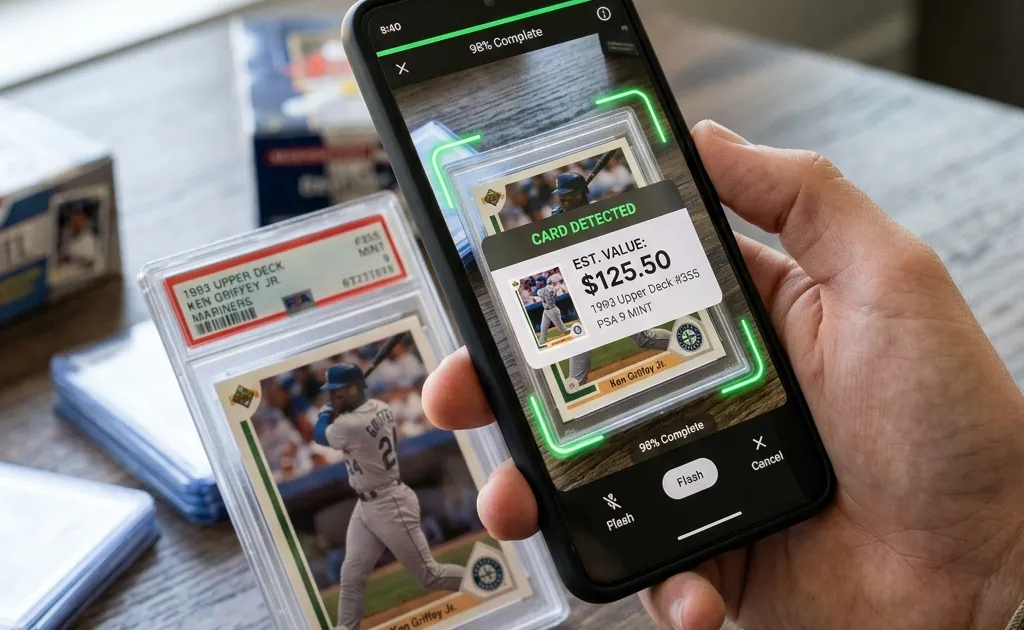
You can look up a baseball card’s value without buying a price guide or paying for an appraisal. The difficult part is not finding a price on the internet. It is making sure the price belongs to the same card, variation, condition, and grade as the card in your hand.
The free process is straightforward:
- identify the player, year, manufacturer, set, and card number;
- determine whether the card is a base card, insert, parallel, autograph, memorabilia card, error, or variation;
- assess whether it is raw or professionally graded and note its condition;
- find several recent completed sales for the closest match;
- remove mismatches and unusual outliers;
- use the remaining sales to estimate a reasonable range.
A baseball card scanner can speed up the first step, but it should not replace verification. This guide shows how to complete the entire lookup for free.
Step 1: identify the exact baseball card
Start with the card itself, not a price. Record these details:
- player name and team;
- copyright or release year;
- manufacturer, such as Topps, Bowman, Upper Deck, Fleer, Donruss, or Panini;
- product or set name;
- card number, usually printed on the back;
- rookie-card logo or designation;
- serial number, such as 17/99;
- autograph or memorabilia feature;
- visible color, foil, refractor, border, or image variation;
- grading company and grade, if the card is in a slab.
The copyright year can differ from the season shown on the front, especially for cards released late in a calendar year. Search both possibilities if the first lookup produces no convincing match.
Use the card number
The card number is one of the most useful identifiers. A search for a player name alone may return hundreds of cards from different years and products. Add the year, set, and number to narrow the results.
For example, a useful search structure is:
year + manufacturer + set + player + card number + parallel or grade
Do not copy an example result simply because the photograph looks similar. Manufacturers often reuse images across products or create many parallels from the same base design.
Step 2: decide whether it is a base card or variation
Modern baseball products can include dozens of versions of one checklist number. The difference may be a border color, foil pattern, refractor finish, image variation, serial stamp, autograph, or memorabilia window.
Inspect the card under angled light and compare:
- border and background color;
- reflective or rainbow finish;
- printed terms such as Refractor, Chrome, Gold, or Heritage;
- stamped serial number;
- autograph certification wording;
- a different photograph from the standard base card;
- code numbers or variation identifiers on the back.
If you cannot confirm the variation, search for a checklist from the manufacturer or a reputable set reference before assigning a value. A rare parallel price applied to a common base card is one of the most frequent lookup errors.
Step 3: separate raw and graded cards
A raw card has not been graded by a third-party grading company. A graded card should be compared with cards from the same company and, ideally, the same numerical grade.
Do not use a PSA 10 sale to value a raw copy. Professional grading reflects an independent condition opinion, authentication, population, and buyer confidence. Even two slabs with the same number can trade differently because of eye appeal, the grading company, label type, or market timing.
When evaluating a raw card, inspect:
- centering on the front and back;
- corner sharpness;
- edge chipping or paper loss;
- scratches, print lines, dents, and surface wear;
- creases, stains, writing, trimming, or restoration.
PSA publishes its official card grading standards, which are useful for understanding the condition attributes professional graders examine. A home inspection is not the same as an official grade, so use conservative comparisons.
Step 4: find free completed-sale data
Active listings show what sellers are asking. They do not prove that a buyer paid that amount. For value research, completed sales are generally more useful.
Search an online marketplace using the exact identifiers you recorded. On eBay, use its search tools and completed or sold filters where available. eBay’s own trading-card guidance distinguishes graded and ungraded card conditions, which is another reason to keep those groups separate.
Try several searches rather than one long query:
- exact year, set, player, and card number;
- the same search plus the parallel name;
- the same search plus the grading company and grade;
- an alternate set abbreviation if collectors use one;
- a search without the team name if it removes relevant results.
A scanner app can suggest the search terms. Our sports card scanner guide explains how lighting and framing affect identification.
Step 5: remove mismatched sales
Open individual results and compare them with your card. Exclude a sale when it is:
- a different parallel or image variation;
- a reprint, custom card, or unlicensed reproduction;
- part of a multi-card lot;
- a different grade or grading company;
- an autograph when yours is unsigned;
- a numbered version with a different print run;
- badly damaged when yours is clean, or vice versa;
- an accepted-offer listing where the visible asking price may not equal the final amount;
- an obvious outlier that cannot be supported by other sales.
Also check the sale date. Player performance, injuries, awards, Hall of Fame news, product releases, and broader collector demand can move prices. A sale from several years ago may provide context but not a current value.
Step 6: calculate a reasonable value range
After removing mismatches, use several recent sales rather than selecting the highest result. If the remaining prices are close together, the range may be reasonably stable. If they are widely dispersed, investigate why.
Differences may come from:
- condition or centering visible in the photographs;
- auction timing and number of bidders;
- seller reputation;
- shipping included in one price but not another;
- a more desirable serial number;
- a mislabeled result;
- temporary player or team news;
- unusually strong or weak eye appeal.
Record the low, middle, and high relevant sales along with their dates. That gives you a transparent range you can update later. Do not present the midpoint as a guaranteed sale price.
What if there are no recent sales?
Scarce cards sometimes have no exact recent comparison. In that case, widen the research carefully:
- look for the same card in a nearby grade;
- compare another parallel with a similar print run;
- look at other cards of the same player from the same product;
- review older exact sales and account for market changes;
- consult a specialist dealer or auction house for a genuinely rare card.
Each step introduces uncertainty. Explain the comparison rather than claiming an exact value. For a high-value, unusual, or potentially altered card, a professional authentication or appraisal may be more appropriate than a free lookup.
Common baseball card value lookup mistakes
Using the highest asking price
Anyone can create an ambitious listing. A high asking price is not evidence of market value unless comparable cards actually sell near it.
Ignoring the card back
The back often contains the card number, copyright line, set wording, serial stamp, or certification details needed to separate similar cards.
Comparing different grades
A raw card, PSA 8, PSA 9, PSA 10, BGS 9.5, and SGC 10 are different market segments. Keep comparisons as close as possible.
Missing a reprint
Iconic vintage and rookie cards are frequently reprinted or counterfeited. Check print quality, dimensions, stock, registration, known identifiers, and provenance. Do not rely on a camera match to authenticate a valuable card.
Treating a scanner estimate as an appraisal
A scanner can help identify a card and organize market data. It cannot physically inspect alterations, subtle surface damage, trimming, or authenticity from one ordinary phone image. Read our valuation methodology for the limitations we apply to estimates.
A repeatable free lookup checklist
Before recording a value, confirm that you can answer “yes” to each item:
- I know the year, manufacturer, set, player, and card number.
- I checked whether it is a base card, insert, parallel, autograph, relic, error, or variation.
- I kept raw and graded comparisons separate.
- I matched the grading company and grade where possible.
- I reviewed several completed sales rather than one asking price.
- I excluded lots, reprints, different cards, and suspicious outliers.
- I noted the sale dates and used a range.
- I understand that the result is an estimate, not a guaranteed selling price or official appraisal.
If you are preparing to sell, continue with our guide to selling sports cards for the best net result. If the card will remain in your collection, learn how to store sports cards safely.
Start with a free baseball card scan
Use the free baseball card scanner and value lookup page to begin with a suggested identity, then verify the physical details and follow the completed-sale process above. For other sports, visit the sports card value scanner and select the matching workflow.
Identify and Research Your Sports Cards
Download the Sports Card Scanner & Value app to identify, catalog, and track baseball, basketball, and football cards. Confirm the exact card and condition before relying on an estimate.