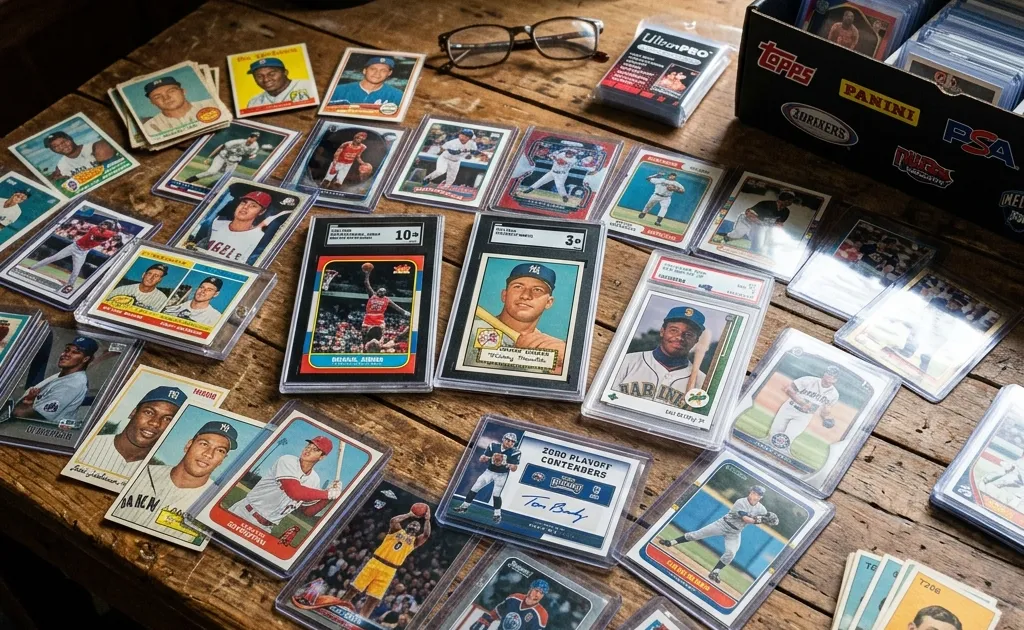
When collectors discuss the most iconic baseball cards of the modern era, one card universally tops the list: the 1989 Upper Deck Ken Griffey Jr. #1.
As card #1 in Upper Deck’s inaugural 1989 high-end set, “The Kid’s” smiling portrait set off a revolution in sports card collecting. Decades later, it remains one of the most liquid and heavily traded cards in the entire sports card market.
Whether you pulled one from a dusty binder or found a copy in an old shoe box, here is the complete 2026 valuation guide for the 1989 Upper Deck Ken Griffey Jr. rookie card.
1989 Upper Deck #1 Ken Griffey Jr. Value by Grade
Card condition is everything when determining value. The 1989 Upper Deck set was notorious for centering issues and top-left foil stamping defects.
Here are the current market pricing benchmarks based on recent sales comps:
| Grade | Estimated Market Value Range | Key Condition Factors |
|---|---|---|
| Raw (Ungraded) | $45 – $90 | Clean surface, crisp corners, good centering. |
| PSA 7 (Near Mint) | $65 – $110 | Minor edge wear or slight centering off-set. |
| PSA 8 (NM-MT) | $120 – $180 | Minor corner softness under magnification. |
| PSA 9 (Mint) | $250 – $380 | Sharp corners, clean reverse, 60/40 centering. |
| PSA 10 (Gem Mint) | $1,800 – $2,500+ | Flawless corners, 55/45 centering, zero foil flaking. |
| BGS 9.5 (Gem Mint) | $800 – $1,200 | Strong quad sub-grades (Centering, Corners, Edges, Surface). |
Pro Tip: Have a Griffey rookie card in hand? Use the free Sports Card Scanner & Value App to scan the card with your camera and get instant market comps and estimated grades in seconds.
The 5 Other Ken Griffey Jr. Rookie Cards to Know
While the 1989 Upper Deck #1 is the flagship, Griffey featured in five other major 1989 base rookie releases:
- 1989 Bowman #220 (The “Tiffany” parallel commands $1,500+ in PSA 10).
- 1989 Fleer #548 (Features the iconic yellow border).
- 1989 Donruss #33 (The Rated Rookie logo card).
- 1989 Score Traded #100T (Part of the post-season update set).
- 1989 Topps Traded #41T (Classic Topps wood-grain design).
How to Spot Fake & Counterfeit 1989 Upper Deck Griffey Cards
Because of its extreme popularity, the 1989 Upper Deck #1 is one of the most counterfeited cards in history. When checking your copy, look for these three key authentication markers:
1. The Reverse Hologram Shape
Upper Deck placed a silver tamper-proof diamond hologram on the back of every 1989 card.
- Authentic 1989 Copy: Hologram has squared/pointed corners.
- 1990 Reprint Copy: Upper Deck changed the hologram shape to rounded corners in 1990. If your 1989 card has rounded hologram corners, it is a later reprint or counterfeit.
2. High-Resolution Dot Matrix Printing
Examine the Upper Deck logo and Griffey’s jersey with a jeweler’s loupe. Genuine cards feature clean vector print lines. Poorly printed fake reproductions show heavy dot-pattern blurring (halftone dots) over solid black text areas.
Is It Worth Grading Your Ken Griffey Jr. Rookie Card?
Grading costs typically range from $15 to $25 per card through PSA or SGC.
- If your raw card appears to be in PSA 9 or 10 condition (perfect centering, no surface print spots, zero corner whitening), grading is highly profitable, boosting card value from $60 to $250+ (PSA 9) or $2,000+ (PSA 10).
- If the card has visible corner wear or is off-center, raw market value ($45 – $75) remains the safest exit price.
Instantly Value Any Sports Card with Your Phone
Unsure what your baseball, basketball, or football cards are worth?
Download Sports Card Scanner & Value on iOS or Android. Simply point your camera at any card to get instant card identification, eBay sold comps, and total portfolio tracking free.
Get Instant Sports Card Values
Download the Sports Card Scanner & Value app to instantly identify, catalog, and track your baseball, basketball, and football cards using your phone camera.