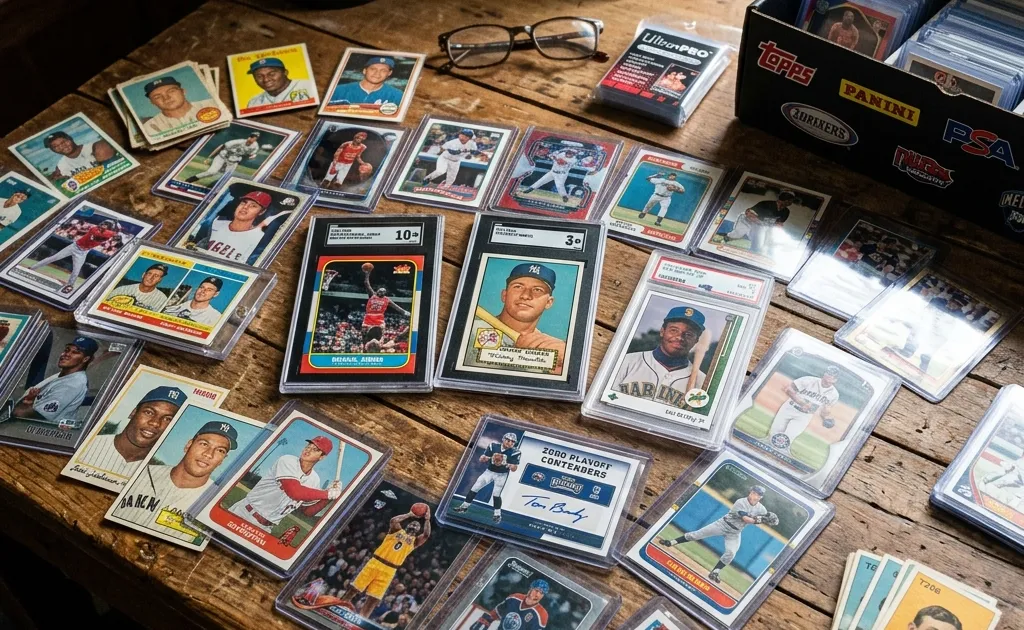
PSA, Beckett (BGS), and SGC labels should be compared as separate evidence groups. Start with the exact card, then record the service, numeric grade, qualifiers, subgrades, authentication wording, and certification details. A PSA 9, BGS 9, and SGC 9 are labels from different systems; they are not a guaranteed conversion table.
The practical question is not which company is universally “best.” It is which label and evidence match the card, the buyer or selling channel, and the decision you need to make. Use this guide to build a clean comparison before you research completed sales or decide whether grading is worthwhile.
For the full identification-to-estimate process, follow the sports card valuation guide and keep the grading decision alongside its source evidence.
What each label tells you
| Label evidence | What it can establish | What it cannot establish by itself |
|---|---|---|
| Service name | Which company evaluated or authenticated the item | That another company’s grade would match |
| Numeric grade | The service’s condition assessment under its current standards | A guaranteed sale price or future grade |
| Subgrades | Beckett’s component observations when present | A universal weighted formula for every service |
| Qualifier or designation | A disclosed limitation, alteration concern, or special status | That the card is equivalent to an unqualified label |
| Certification number | A reference to check against the service database | That the physical holder or card cannot be counterfeit |
The numeric labels are not interchangeable
The services’ own scales make the difference concrete:
| Service | Official designation examples | Practical comparison point |
|---|---|---|
| PSA | Numeric grades on its published 1-to-10 standards, with qualifiers or special designations where applicable | A PSA 10 is a PSA-standard result; it does not become a BGS Pristine 10 or an SGC 10 PRI by conversion. |
| Beckett/BGS | Pristine 10, Gem Mint 9.5, Mint 9, and other half-point grades | Beckett says final grades can use half-point increments, and a label can show four subgrades. A BGS 10 may be labeled Pristine, while a BGS 9.5 is Gem Mint. |
| SGC | 10 PRI (Pristine), 10 GM (Gem Mint), 9.5, 9, and further half-point grades | SGC’s own scale distinguishes 10 PRI from 10 GM. The word next to the number is part of the result, not decoration. |
This is why “same 10” is an unsafe shortcut. A numeric 10 can carry a different designation, subgrade structure, centering description, or service-specific threshold. Read the official scale linked below and copy the complete label before creating a comparison row. This table is a label-reading aid, not a claim that one service is better or that a grade can be translated mathematically.
PSA publishes its grading standards, including condition definitions, centering guidance, qualifiers, and no-grade examples. Beckett publishes its grading scale and describes evaluations across centering, corners, edges, and surface. SGC provides its own service information and grading scale. These are primary service references, not a promise that their labels are interchangeable.
PSA: record the grade and any qualifier
PSA uses a 1-to-10 scale for trading cards and may include qualifiers or authentication designations. When you record a PSA result, copy the complete label rather than only the large number. A qualifier, “Authentic” wording, or an altered-card designation changes the comparison cohort.
PSA’s standards explain that eye appeal can matter alongside measurable defects. They also identify conditions such as trimming, recoloring, restoration, questionable authenticity, and cleaning that can lead to a no-grade result or a special designation. That means a front photograph and a number are not enough to tell the full story. Record the label, the front and back images, and the service’s verification result.
Use PSA Cert Verification as a consistency check. Match the returned player, set, card number, grade, and label wording to the physical item. PSA warns that a copied certification number can appear on a counterfeit insert, so a database match is not a substitute for examining the holder and card.
BGS: subgrades are additional evidence
Beckett grading commonly presents an overall grade with component subgrades. Record centering, corners, edges, and surface separately when they appear on the label. A subgrade can explain why two cards with the same overall number belong in different research rows, but it does not create a universal conversion to PSA or SGC.
Beckett’s own grading scale describes the characteristics it evaluates. Use that source to understand the service’s language, then inspect the actual label and certification record. Do not infer a missing subgrade, and do not turn a seller’s “BGS-ready” description into a grade.
Beckett also has separate authentication and grading offerings. Do not treat a Beckett authentication result, an older BVG label, or another Beckett-branded service as automatically equivalent to a current BGS card-grade label. Identify the service named on the holder and the exact certificate or label language first; then keep unlike products in separate research cohorts.
For a BGS comparison, preserve the exact overall label, every visible subgrade, any “Authentic” or altered wording, and the certification reference. If a listing photograph hides the subgrades, mark the row incomplete rather than filling the gap from a search snippet.
SGC: keep the service cohort intact
SGC’s grading scale is its own framework. Record the grade, label designation, authentication or alteration language, and certification information exactly as displayed. A card in an SGC holder may be visually similar to one in a PSA or BGS holder, but the service and label remain part of the item being compared.
When a market report groups labels together, read the underlying cards. A combined “graded” filter can hide differences in service, grade distribution, qualifiers, card era, and buyer demand. For a narrow estimate, separate SGC from PSA and BGS before deciding whether a pooled view is informative.
Build identity before comparing labels
The label does not replace card identification. Record year, manufacturer, product, player, card number, base or insert status, parallel, serial number, autograph or memorabilia language, and any variation. Use the sports card scanner as a starting clue, then confirm against a checklist or reliable reference.
Two cards can share a player, photograph, and number while belonging to different products. A base card and a refractor, a regular issue and an image variation, or a card with and without a serial stamp are separate comparison problems. If the exact identity is unresolved, pause the value comparison.
A label-comparison worksheet
Create one row for the target and one for each candidate sale. Keep known facts and uncertainty visible.
| Field | Target | Candidate sale |
|---|---|---|
| Year, product, card number | ||
| Player and team | ||
| Base, insert, parallel, serial | ||
| Raw or grading service | ||
| Overall grade | ||
| Subgrades, if shown | ||
| Qualifier or designation | ||
| Certification checked | Yes / no / unclear | Yes / no / unclear |
| Sale date and transaction state | ||
| Photo and identity confidence | High / medium / low | High / medium / low |
| Include or exclude, with reason |
The inclusion decision is part of the research. If the candidate is a different parallel, has an unclear grade, or shows a questionable transaction state, explain the exclusion instead of silently dropping it.
Compare completed sales fairly
Use eBay’s Product Research guidance to distinguish actual transaction evidence from active asking prices. Search using the full identity and filter the service and grade where possible. Open the listing, confirm the card photograph, record the date, and note whether an accepted offer amount is visible.
Keep these cohorts separate:
- PSA, BGS, and SGC, even when the overall number looks similar.
- Unqualified labels and labels with qualifiers or special designations.
- Cards with and without autograph or memorabilia authentication.
- Exact parallel and serial-number groups.
- Same grade, adjacent grade, and raw cards.
If the sample is sparse, say so. A single matching sale is an observation, not a stable market range. Do not invent a midpoint to make a table look complete.
When a pooled comparison is useful
A broad pooled view can help answer a discovery question such as “are graded examples appearing at all?” It is weak evidence for a pricing decision unless you also show the service mix, grade mix, card identity, and transaction dates. The more diverse the pool, the less useful its average becomes.
For a serious sale or collection decision, report the narrow cohort first. Add a broader context row only when its limitations are explicit. Link the work to How to Find and Compare Sports Card Sold Comps and Raw vs. Graded Sports Card Value.
Grading, authentication, and value are different questions
A grading service can assess condition and may offer authentication services, but a grade does not guarantee a sale amount. A certification lookup does not prove that every physical item carrying the number is genuine. A sold price reflects a particular date, buyer, listing, and transaction state.
If you are deciding whether to submit a raw card, list grading fees, shipping, insurance, declared-value rules, turnaround, and the possibility of a lower grade as separate inputs. Read Should You Grade a Sports Card Before Selling It? and Is Sports Card Grading Worth It? before treating a higher graded observation as a profit forecast.
A safe conclusion format
State the exact identity, service cohorts, grade distribution, date window, sample size, and unresolved fields. A useful conclusion might say that three PSA 9 sales are the closest evidence, that BGS and SGC examples were retained as context, and that the target’s parallel is not confirmed. That is more honest and more reproducible than saying one service always commands the highest price.
Photograph and preserve the evidence
Keep a front photograph, back photograph, label close-up, and certification-result screenshot together with your research notes. Photograph at a consistent distance and save the date, because a later listing may show a different holder or a different description. Do not crop away corners, edges, or the certification number when those details are part of the question. If a card changes hands, the evidence packet helps you distinguish the original item from a similarly described card. It also makes a later completed-sale comparison easier: you can explain exactly which service, grade, qualifier, parallel, and condition evidence led you to include or exclude a result.
Editorial and source notes
Reviewed October 29, 2026 by the SportsCardValue Editorial Team. PSA, Beckett, and SGC standards and services can change; consult the current primary pages before submitting a card. This guide is educational research, not grading, authentication, appraisal, or investment advice.
Identify and Research Your Sports Cards
Download the Sports Card Scanner & Value app to identify, catalog, and track baseball, basketball, and football cards. Confirm the exact card and condition before relying on an estimate.