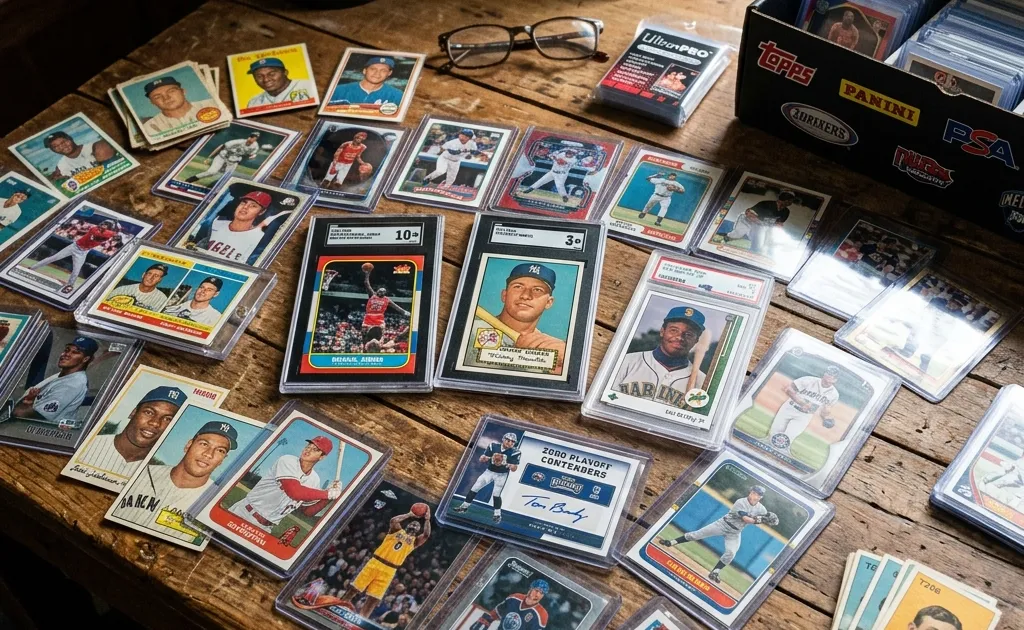
To find useful sports card sold comps, first identify the exact card and then compare only completed transactions that match its set, variation, condition, and grade status. Record the sale date, format, stated condition, shipping treatment, and any uncertainty. A list price is a seller’s intention; a sold comp is a marketplace record of a reported transaction; it may not establish payment or the outcome of a later return.
This guide gives you a repeatable research ledger. It does not publish a price for a card you have not identified, and it does not turn a small or mixed sample into a precise appraisal. Use the sports card value scanner for identification clues, then confirm the result with the valuation guide and the site’s methodology.
Build a comp research packet
Before searching, photograph both sides and write down what is visible. Include player, sport, year, manufacturer, product, card number, insert or parallel, serial number, autograph or memorabilia language, raw or slabbed status, grading company, grade, and notable qualifiers. If a field is unknown, write “unknown” rather than guessing.
Your packet should answer one question: what exact object are you comparing? “2023 rookie card” is not enough. A base card, silver parallel, short print, autograph, and memorabilia card may share a photograph while belonging to separate markets.
Choose a search source and understand its limits
eBay’s official Product Research documentation says its tool can search up to three years of sales, report actual prices including accepted Best Offers, and calculate ranges, averages, shipping, and sell-through metrics. Completed-listing results can include sold and unsold listings; select sold results and confirm the status, while Product Research is a longer-window research tool. Results depend on the specificity of the search, so a broad query can mix unrelated cards. See eBay Product Research and eBay’s Product Research overview.
Other marketplaces and auction archives can add context. Record the source and currency for every row. Do not merge a marketplace’s displayed asking price with a completed sale or assume that a result labeled “ended” sold. If the final transaction status is unclear, mark it excluded or uncertain.
The sold-comps selection workflow
1. Start with the narrowest complete identity
Search the player, year, product, card number, and variation. Add the serial-number denominator when it matters, but do not search only a serial suffix: 17/99 identifies one copy’s number, not the entire variation. Add “raw,” the grading service, or the grade only when those details describe the target.
2. Inspect the listing, not only the title
Open each candidate. Confirm the front and back, checklist identity, card number, parallel, serial numbering, autograph or relic statement, slab label, and visible damage. A title can be wrong or incomplete. A photograph can also hide a crease or altered surface, so log what the listing does and does not establish.
3. Separate comparable cohorts
Do not average raw cards with graded cards, different grading services, base cards with parallels, or signed cards with unsigned cards. A useful sample may have several cohorts, each with its own range. If a cohort has one observation, call it a single observation and avoid describing it as a market range.
4. Record transaction details
Capture date, source, item identity, condition/grade, sale format, displayed sold price, shipping if shown, currency, and notes. An accepted offer may be displayed differently from an original asking price. Use the marketplace’s actual transaction field when available. Never infer a sale amount from a crossed-out list price.
5. Exclude and explain outliers
Exclude a result when the card is a different variation, a lot, an empty holder, a reprint, a damaged copy with no comparable condition, or a listing whose sold status cannot be verified. Keep a reason code. A high or low sale is not automatically an error; it may reflect a different grade, buyer location, timing, or disclosure.
A research ledger you can copy
| Field | Entry to record |
|---|---|
| Target identity | Player, year, product, number, variation |
| Target state | Raw or slabbed; service, grade, qualifier |
| Candidate URL or ID | Stable marketplace link or archive reference |
| Sale date | Date shown by the source |
| Sold status | Confirmed, unclear, or excluded |
| Price field | Actual sold price and currency; shipping separately |
| Match notes | Why the candidate matches or differs |
| Inclusion code | Include, cohort-only, uncertain, or exclude |
| Evidence gap | Missing photo, unclear grade, altered wording, etc. |
Use the ledger before calculating anything. It makes your conclusion auditable and prevents a compelling thumbnail from becoming an unsupported number.
How to summarize a small sample
Report the cohort, date window, sample count, and spread. A median can be useful when several genuine matches exist, but it is still a description of that sample, not a guaranteed value. State whether shipping, buyer premium, taxes, or currency conversion are included. Keep the original rows so a reader can challenge an inclusion decision.
Illustrative example: a worksheet contains four confirmed raw base-card sales and two graded sales. The correct output is two separate cohorts with their dates and ranges. It is not one six-row average. No dollar amount is supplied here because a hypothetical amount would look like a real market claim.
Common failure modes
“Same player” is not the same card. “Rookie” is not a complete identity. A slab grade is not transferable to a raw card. A serial number does not prove authenticity. A sold listing with a blurry photograph may be a lead for investigation, not evidence strong enough for inclusion.
Do not use active listings to create a sold range. Do not copy a search snippet without opening the record. Do not use an average when the sample combines multiple variants. Do not state that one marketplace represents every collector. If no credible comp exists, report that the market is thin and explain what additional evidence would help.
From comps to a decision
If you are deciding whether to list, use the closest confirmed cohort and disclose differences. If you are deciding whether to grade, compare the raw cohort with a separately defined graded cohort and account for grading cost outside the card’s market observation. If you are cataloging a collection, retain the ledger and schedule a refresh because prices and available records change.
For the next question, read sold price versus asking price, then compare raw and graded card value. For sport-specific details, use the basketball value guide or football price guide. The goal is a transparent research record that another collector can reproduce, not false precision.
A confidence note for every conclusion
Use a short confidence note beside the final range. High confidence means several recent records match the complete identity, sold status is clear, and condition or grade is comparable. Medium confidence means the identity is strong but the cohort is small, older, or missing a field such as shipping. Low confidence means the search depends on approximate titles, unclear photographs, or a single observation. Confidence is a description of the evidence you collected, not a prediction of a future price.
When records disagree, investigate before averaging. Check whether one row is an auction and another is fixed price, whether one includes a buyer premium, whether one is a lot, and whether one is a reprint or a different parallel. A disagreement can reveal a missing identity field. It can also show that the market is thin. Keep both the raw rows and your reasoning so a future refresh can correct the conclusion without starting over.
If the target is an ungraded card and only slabbed records exist, say so. You may cite those records as context, but they do not become direct raw comps. If the target’s serial number is unknown, do not borrow a numbered-parallel range. If a marketplace removes a listing, retain the URL and mark the result as unavailable rather than reconstructing a price from a screenshot or search snippet.
Save the query wording with the date. Repeating the same narrow search later makes changes easier to interpret and reduces accidental cherry-picking.
Keep a copy of the source’s displayed currency and date format. If you convert currency later, preserve the original value and conversion date alongside it.
Worked example: a numbered parallel
Suppose the target is a numbered basketball parallel with an unreadable suffix. Start by recording the player, product, card number, and the visible denominator. Search the exact product and card number first, then inspect candidate photos for the same parallel finish. Exclude a base card even when the player and photograph match. If two candidates show different denominators, keep them in separate cohorts. If no candidate displays the back, mark the serial field unresolved. The result might be “identity confirmed; parallel family likely; serial variant unresolved,” which is more useful than borrowing a high sale from a similar-looking card.
Clear records are more useful than impressive-looking guesses when a collector revisits the card months later.
Editorial and source notes
Reviewed October 28, 2026 by the SportsCardValue Editorial Team. Marketplace interfaces and data windows can change; verify the source’s current definition before recording a result. This article explains research and is not a professional appraisal, authentication opinion, or financial advice.
Identify and Research Your Sports Cards
Download the Sports Card Scanner & Value app to identify, catalog, and track baseball, basketball, and football cards. Confirm the exact card and condition before relying on an estimate.