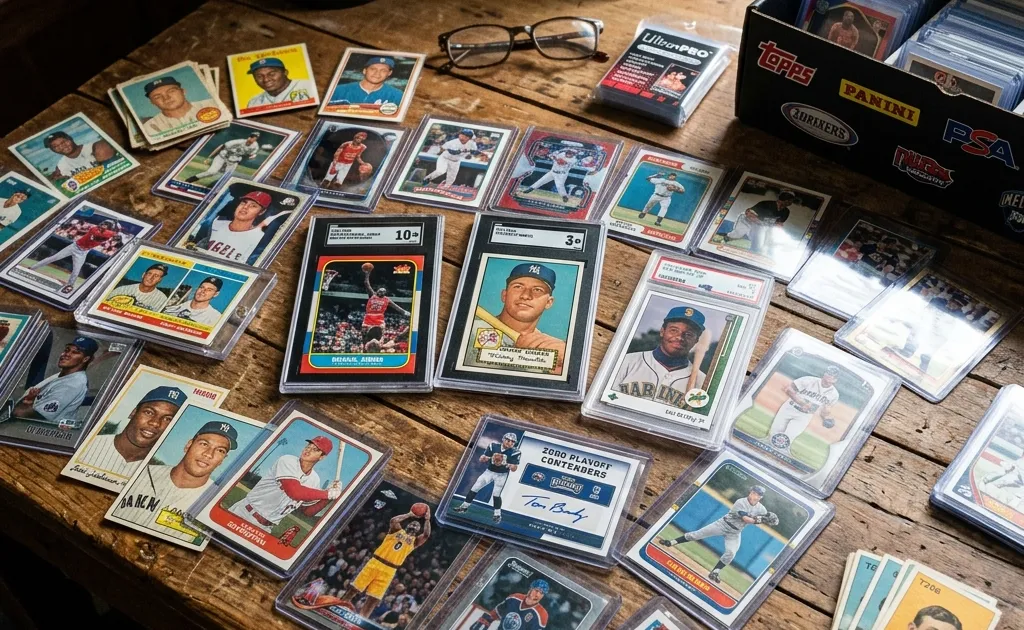
Raw and graded sports cards should be researched as separate comparison groups. A raw card has no grading-service opinion attached; a graded card has been encapsulated and labeled by a particular service with a particular grade and possible qualifiers. To compare them fairly, match the exact card first, then keep service, grade, qualifier, autograph status, and visible condition separate.
Do not treat a raw card as a guaranteed future high grade, and do not apply one service’s label as if every service uses the same process. A grade describes the card as examined under that service’s standards at that time. It does not authenticate every element of a card or guarantee a future sale price.
What “raw” describes
Raw means the card is being considered outside a grading holder. It may be freshly pulled, stored in a sleeve, previously handled, or altered; the word alone does not establish condition. Record corners, edges, surface, centering observations, print lines, creases, trimming concerns, and whether the back is available.
The safe comparison is “raw candidate with these visible characteristics,” not “raw equals grade 9.” A photograph can miss a surface issue, and centering measurements can be affected by borders, design, and image perspective. State the limits of a remote review.
What a graded label adds
A slab label normally identifies a service, card description, and grade. Some labels add qualifiers or authentication designations. Read the full label and verify the certification through the service’s current tool where available. PSA publishes its grading standards, and Beckett publishes grading information. These references describe the services’ own frameworks; they are not a universal conversion table.
SGC, PSA, Beckett, and other services can differ in label conventions, half-point use, qualifiers, authentication offerings, and market perception. Our PSA, BGS, and SGC comparison summarizes the practical differences, while the sports card condition guide helps you record the underlying card condition. A PSA grade and a BGS grade should therefore be separate cohorts in a sold-comps worksheet. Do not claim a direct numeric equivalence without evidence for the exact cards and market.
Check the certification without assuming authenticity
For a PSA holder, enter the printed number in PSA Cert Verification. Compare the returned card description and grade with the listing photograph. PSA explicitly warns that a valid database number does not prove the physical item being offered is genuine: a copied number can appear on a counterfeit insert. Treat the lookup as a consistency check, and retain the photograph and source of the offered card.
In your worksheet, keep three separate fields: the number you read, the result returned, and any mismatch. If the lookup describes another player, another variation, or a different grade, pause that comparison. Do not change the target’s identity merely to make the listing fit. If a photo is too blurred to read the number, mark verification incomplete and request a clearer image before relying on it.
The same record can prevent double counting. Two listings showing the same certification number may depict the same physical card offered or resold at different times. Keep their dates and transaction status visible instead of presenting them as evidence from two independent copies.
Build the identity before comparing value
Record year, manufacturer, product, card number, player, base or insert status, parallel, serial numbering, autograph or memorabilia wording, and any variation. Use the sports card scanner as a starting clue and confirm with a checklist or reliable reference. A graded label can contain a shortened description; the holder does not remove the need to verify identity.
Keep these comparison groups separate
| Group | Keep constant or record explicitly |
|---|---|
| Raw | Visible condition, centering observations, surface and alteration concerns |
| PSA graded | PSA label, numeric grade, qualifier, authentication wording |
| Beckett graded | BGS label, subgrades when present, numeric grade, qualifier |
| SGC graded | SGC label, numeric grade, qualifier, authentication wording |
| Autographed | Signer, card status, authentication or certification, condition |
| Memorabilia | Relic language, player-use wording, patch or swatch details |
The table is a data structure, not a promise that every card in a group is interchangeable. Within a group, the exact set, variation, and card condition still matter.
A fair comparison worksheet
For each candidate sale, record:
- Card identity and checklist reference.
- Raw or graded status.
- Service, grade, qualifier, and certification reference if graded.
- Autograph, relic, or altered-card disclosure.
- Sale date, source, sold status, currency, and shipping treatment.
- Photo evidence and any uncertainty.
- Inclusion cohort and reason for exclusion when omitted.
Then make one row for the target and one row for each comp. The target row should say what is known and what remains unresolved. A market comparison is stronger when a reader can see why a candidate was not used.
Why grade alone does not explain a difference
Two cards with the same numeric grade can differ in eye appeal, population, qualifiers, autograph status, scarcity, and demand. Two cards with different services can attract different buyer groups. A grade also does not erase a mismatch in product or parallel.
Illustrative example: a raw silver parallel, a graded base card, and a graded silver parallel may show the same player image. They are three different comparison problems. Keep them separate until identity and status are confirmed. No price is assigned here because a made-up amount would falsely resemble a reported sale.
Research sold evidence responsibly
Use the sold-comps workflow in How to Find and Compare Sports Card Sold Comps. eBay says its Product Research tool can show actual prices, including accepted Best Offers, and allows filtering by condition and other fields. Search narrowly, inspect the listing, and retain the transaction date and source. Do not mix active asking prices with completed transactions.
For graded cards, confirm the service and grade from the listing and, where possible, the certification record. A seller’s title can contain an incorrect grade. For raw cards, do not infer a grade from marketing language such as “gem” or “mint.” Treat it as the seller’s description, not a grading result.
Altered, trimmed, and questionable cards
An altered card, reback, trimmed edge, recolored surface, or counterfeit should not be compared with ordinary raw cards without an explicit separate cohort. A holder or label may contain a qualifier that changes how the market treats the card. If the listing does not reveal enough, mark it uncertain and exclude it from a clean range.
Autographs and memorabilia require the same discipline. “Game-used,” “player-worn,” “event-worn,” and “not from any specific game or event” are different statements. A patch color or signature alone does not prove authenticity or usage. Keep these cards separate from unsigned base-card evidence.
How to write the conclusion
State the target identity, comparison cohorts, date window, sample size, and evidence gaps. Say whether the result is a research range, a single observation, or insufficient evidence. Avoid a single precise number when the sample is mixed or sparse. Link back to the valuation methodology and the sports card valuation guide for the broader decision.
If you are choosing whether to submit a raw card for grading, read should you grade a sports card before selling it? and is sports card grading worth it? alongside the factors that make sports cards valuable, the card’s condition, and current market evidence. Add grading fees, shipping, insurance, turnaround, and downside risk as separate decision inputs. A higher graded-comp observation does not prove that submission will be profitable. If you are selling a slab, disclose the service, grade, qualifier, and certification details accurately.
A submission decision without grade speculation
Start with the card’s identity and a condition inventory. Next, build separate raw and graded cohorts using the worksheet. Then list the costs and practical constraints of submission: service fees, shipping both ways, insurance, declared value rules, turnaround, and the possibility that the returned grade or qualifier will not match an optimistic estimate. These inputs belong in a decision table; none should be silently folded into a card’s observed sold price.
Illustrative decision table:
| Question | Evidence to collect | Safe conclusion |
|---|---|---|
| Is the card identified? | Checklist and front/back images | Resolve identity before pricing |
| Is condition documented? | Corners, edges, surface, centering notes | Describe uncertainty; do not predict a grade |
| Is there a matching raw cohort? | Recent confirmed raw transactions | Use as raw context only |
| Is there a matching graded cohort? | Same card, service, grade, qualifier | Compare within that cohort |
| Are submission costs known? | Current service terms and shipping plan | Include as separate costs |
This process can produce a sound next action even when no reliable value range exists. “Hold for better identification” or “seek an authentication opinion” is a useful result. A precise-looking grade forecast is not.
Refresh the evidence
Marketplaces add and remove records, grading services update standards, and labels change. Date your worksheet and revisit it when a new card is identified, a service changes its terms, or the available cohort grows. A future reader should be able to tell which facts came from the card, which came from a service, and which came from a transaction record.
That separation protects the collector from a common mistake: treating a market observation as a guarantee about an individual card. Keep identification, grading, and transaction evidence in separate columns.
When sharing the worksheet, remove private account details and retain only the public listing references needed to reproduce the comparison.
Worked example: deciding what belongs in a cohort
Imagine a target card in a sleeve with a visible surface line and no grade. You find one raw listing, one PSA slab, and one BGS slab for the same product. The raw listing belongs in the raw cohort only if its sold status and identity are clear. The PSA and BGS records remain graded context, separated by service and label. The surface line should be recorded as an evidence gap or condition difference; it is not a reason to predict a grade. Your conclusion can recommend more photographs or professional review without assigning a numeric outcome.
Clear columns keep a promising card from being compared against the wrong market cohort.
Editorial and source notes
Reviewed October 28, 2026 by the SportsCardValue Editorial Team. PSA and Beckett standards are service-specific and can change; consult the current service pages before relying on a label. This guide is educational market research, not authentication, grading, appraisal, or investment advice.
Identify and Research Your Sports Cards
Download the Sports Card Scanner & Value app to identify, catalog, and track baseball, basketball, and football cards. Confirm the exact card and condition before relying on an estimate.