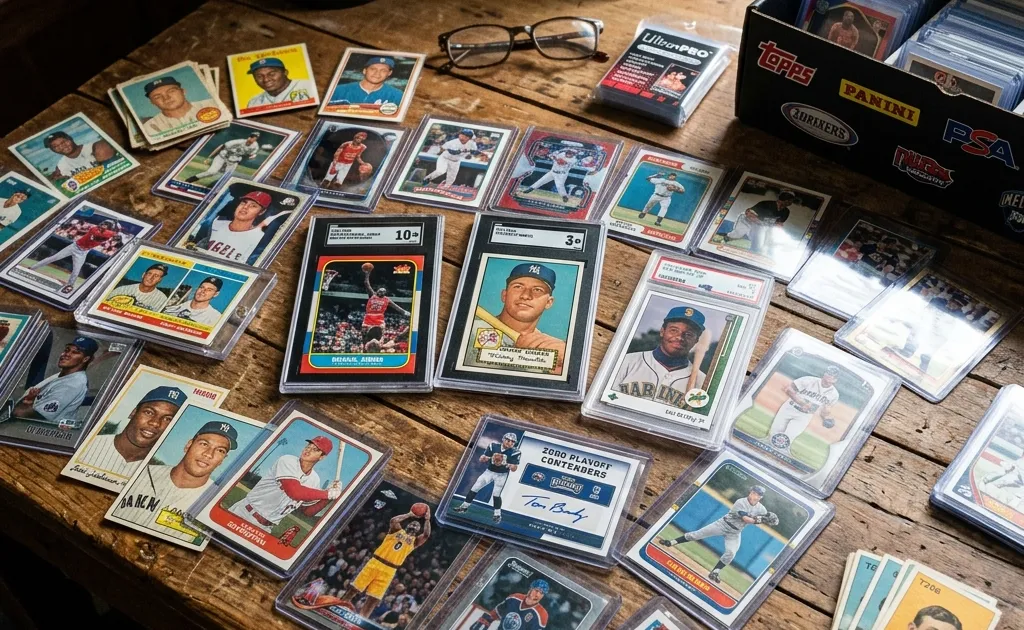
To check a football card price, first identify the exact player, year, product, card number, parallel, serial number, autograph or memorabilia wording, and condition. Then compare recent completed sales for cards with the same attributes. Active asking prices are seller requests; a completed sale is evidence that a buyer and seller reached a transaction under stated conditions.
This process complements the football card scanner, but it does not promise a live price or an automatic appraisal. The scanner can help you form a candidate identity. Your price estimate should explain which sales you selected, why they match, and which differences make the range uncertain.
Build the exact search description
Do not start with “football card value” alone. A broad search mixes decades, products, grades, and variations. Build a compact description from the card itself:
player + year + manufacturer/product + card number + variation + grade or raw
Add “serial-numbered,” “autograph,” or “memorabilia” only when the card supports that description. Keep the complete serial notation in your notes. A card marked 12/99 is not the same comparison as an unnumbered card with a similar color.
| Attribute | Example record | What a mismatch means |
|---|---|---|
| Player | Exact printed name | Do not use a same-team player as a substitute |
| Release | 2024 Panini Prizm Football | A brand name alone is too broad |
| Number | #215 | A serial stamp is a separate field |
| Variation | Silver Prizm, if checklist confirms | Color by itself may be misleading |
| Serial | 12/99 | Compare to other numbered cards cautiously |
| Autograph/material | Exact printed wording | Do not upgrade player-worn to game-used |
| Condition | Raw, slabbed, or grade and company | Raw and graded sales are different populations |
| Completeness | Single card, lot, or box | Lots cannot be used as a single-card comp without adjustment |
If any field is unresolved, pause the price search. Read the football identification guide and use the scanner photography guide to capture the missing evidence.
Use completed listings as market evidence
eBay’s pricing guidance recommends checking completed listings when deciding what similar items have sold for. Its sports-card price guidance can include sold price, sales format, ranges, counts, sale date, and separate graded or ungraded information. eBay’s Product Research documentation explains that Product Research and ordinary completed-listing results cover different time spans and features. Treat the tool you used as part of your research record.
On a normal search, enter the specific description, open the advanced search or filter controls, and select completed or sold listings. Inspect the actual item rather than relying on a title. Sellers sometimes use “rookie,” “prizm,” or “patch” loosely, and a title can omit a grade or serial number.
For each candidate sale, save:
- the listing URL or item identifier;
- the sale date shown by the marketplace;
- the sold amount and whether shipping is separate;
- auction, fixed-price, or accepted-offer context when shown;
- raw or grading company and numeric grade;
- card number, variation, serial number, and memorabilia/autograph wording;
- any obvious issue such as a crease, trimmed edge, incomplete lot, or stock image.
Do not invent a sale from an active listing. If the marketplace hides an accepted offer or only reports a range, record that limitation instead of substituting the displayed asking price.
Select comparable football sales
A good comp is similar in the attributes that drive collector decisions. A sale of the same player and product but a different parallel can still be useful as context, but label it as a secondary comparison. Do not average unlike cards into a false precise price.
Use this order:
- Exact player, product, card number, and variation.
- Exact serial-number range when the card is numbered.
- Same grading company and grade, or raw-to-raw.
- Same autograph or memorabilia type and wording.
- Similar sale format and a recent date.
- Only then use a related card, clearly marked as a fallback.
| Match level | Use | Label |
|---|---|---|
| Exact card and same grade | Main estimate range | Strong match |
| Exact card, raw versus raw | Main range for raw card | Strong match |
| Same card, different grade | Explain grade difference | Adjusted context |
| Same product, different parallel | Context only | Variation mismatch |
| Same player, different product | Demand context only | Product mismatch |
| Lot or box break | Usually exclude | Not a single-card comp |
The aim is not to find a single magical number. It is to explain whether the available evidence is narrow, mixed, old, or sparse.
A no-price worked example
Imagine a raw 2024 football base rookie with a confirmed card number and no serial stamp. You find three recent completed listings: two exact raw cards and one PSA-graded card. The two raw listings are your primary evidence. The graded sale can show that condition and encapsulation matter, but it should not be folded into the raw-card average. If one raw listing is a multi-card lot, remove it from the primary set and explain why.
Now imagine the same player on a gold /10 parallel. The base rookie sales do not answer that question. They can establish player demand, but the /10 card needs exact or closely documented numbered-parallel sales. If only one sale exists, state that the range has low confidence. Do not manufacture a midpoint from unrelated colors.
Calculate a range without false precision
For a small, clean set of comparable sales, report the observed low and high, the middle observation or median if you have enough sales, and the dates. If the sales differ materially, explain the difference instead of hiding it in an average. Include shipping or fees consistently according to the purpose of the estimate.
Avoid phrases such as “the card is worth exactly $X.” A useful report looks like this:
Three recent raw completed sales of the exact card were found. The observed results varied by condition and format. This is a research range, not a guaranteed sale price. No graded sale was included in the raw estimate.
That wording tells the reader what the evidence actually supports. It also makes a later refresh straightforward.
Football-specific condition checks
Before accepting a comp, inspect the listing images and description for football-card issues:
- corner whitening and edge chipping on dark borders;
- surface scratches, print lines, dimples, or roller marks on reflective finishes;
- centering differences, especially on cards with a strong frame;
- soft corners or pressure marks from storage;
- an altered, trimmed, recolored, or cleaned card;
- a slab with a different card number or variation than the title;
- a patch, autograph, or serial stamp that is not visible in the photographs.
PSA’s collector terminology distinguishes terms such as rookie card, reprint, recolored, and restored. Use those distinctions when reviewing a listing. A card that looks similar in a thumbnail may belong to a different condition or authenticity category.
For a graded comp, record the grader, grade, label wording, and certification information as displayed. A grade from one company is not automatically interchangeable with the same number from another company. For a raw comp, do not infer a grade from a seller’s adjective such as “mint.”
Track sale context
Auction and fixed-price sales can reflect different timing and buyer behavior. An accepted-offer sale may display less information than a straightforward sold amount. A listing with several cards may have a low per-card arithmetic result that does not represent a buyer’s valuation of one copy. Shipping, taxes, returns, and buyer fees can also affect what someone actually paid versus what the seller received.
Record context in a worksheet:
| Sale | Exact match? | Date | Format | Condition/grade | Amount shown | Adjustment or exclusion |
|---|---|---|---|---|---|---|
| 1 | ||||||
| 2 | ||||||
| 3 | ||||||
| 4 | ||||||
| 5 |
Then write a short conclusion:
- How many exact matches were found?
- Which sales were excluded and why?
- What condition differences remain?
- What date window did you use?
- What would change your estimate?
Do not treat scanner output as a price guarantee
An image-based suggestion can miss a parallel, card number, autograph statement, or serial stamp. Even a correct identity does not determine a transaction price. Verify the candidate against the physical card and a checklist, then use completed sales for market context. The value checker versus appraisal guide explains the separate roles of estimate, authentication, grading, and formal appraisal.
For a broader workflow, read How to Value Sports Cards, the value checker versus appraisal guide, and the selling guide. Use the football scanner page when the card’s identity is still the missing piece.
Confidence labels for your report
Use a simple label that matches your evidence:
- High: multiple recent exact matches with matching variation and condition category.
- Medium: a few exact matches plus one clearly explained adjustment.
- Low: one old sale, sparse results, or unresolved product/variation details.
- Unknown: no defensible comparable sale was found.
These labels describe the research, not the card’s quality. A rare card can have low confidence because sales are scarce. A common card can have high confidence because many exact sales exist. Avoid converting scarcity of evidence into a claim about rarity.
Refresh the record
Market data changes, product checklists are updated, and a player’s demand can move. Save the date you checked, the sources, the query wording, and the exact fields you matched. Recheck time-sensitive estimates quarterly or sooner when a card has a new release, grade, or major market event.
The editorial team reviewed this method on October 28, 2026. It is a research workflow, not a guarantee of a sale price, appraisal, authentication, grade, or scanner performance. Use primary marketplace records and manufacturer documentation for the card in front of you, and say when those records are unavailable.
Identify and Research Your Sports Cards
Download the Sports Card Scanner & Value app to identify, catalog, and track baseball, basketball, and football cards. Confirm the exact card and condition before relying on an estimate.