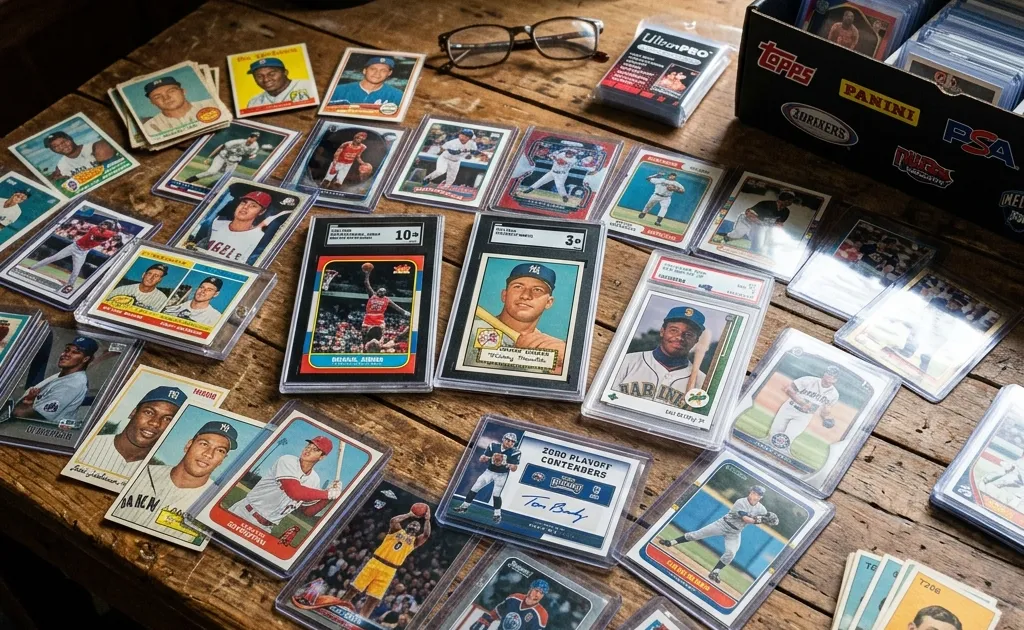
A sports card value checker helps you research a possible market range. A professional appraisal is a valuation assignment prepared for an agreed purpose. They can use some of the same sales evidence, but a scanner result, screenshot, or collection total is not automatically an appraisal report.
If you searched for a sports card appraisal app, first decide what you need the answer for. Sorting a collection and researching a possible listing are different tasks from providing documentation to an insurer or an adviser. SportsCardValue helps with identification and value research; it does not provide certified appraisals, authenticate cards, or assign professional grades.
This guide explains the distinction and gives you a worksheet for deciding your next step. It is educational, not tax, legal, insurance, or investment advice. Professional requirements vary by purpose and jurisdiction; ask the person receiving the report what they require before commissioning work.
Choose the service by the question, not the label
“What is this worth?” can hide several different questions. Use this service-selection matrix to separate them before uploading photos or paying for help.
| Your actual question | Useful starting point | What that step does not establish |
|---|---|---|
| What card am I holding? | Card details, a checklist, or a scanner candidate | Authenticity, professional condition, or a sale price |
| What have similar cards sold for? | A value checker and verified comparable sales | That your card will sell for the same amount |
| Is the card genuine? | A suitable authentication specialist | A purpose-specific appraisal conclusion |
| What is its professional condition grade? | A grading service that accepts the card | A guaranteed selling price or net proceeds |
| What documentation does another party need? | Confirm that party’s requirements, then discuss an appraisal assignment | Automatic acceptance of an app screenshot or grading label |
| What would a dealer pay today? | A clearly described purchase offer | An independent appraisal for another purpose |
These are different outputs, not a ranking of better and worse services. A collector may need only the first two. Another may need several steps, in a different order, because identity or condition is unresolved.
For the identification stage, start with the sports card scanner workflow. Do not carry an uncertain match into a price comparison simply because the app returned a familiar player name.
What a sports card value checker can help you do
A value checker is most useful as a research starting point. It can help you organize the card’s identity, look for comparable market evidence, and decide which cards deserve closer investigation. The quality of your conclusion still depends on the inputs and on whether the evidence actually matches your card.
Before accepting a candidate, verify the year, manufacturer, set, card number, parallel, and any serial numbering. For a graded card, include the grading company and grade. For a raw card, record visible condition without promoting your own description to a professional grade. Our scanner tutorial shows how to capture front-and-back details and check wrong matches.
Then investigate the underlying sales rather than copying a single displayed number. eBay’s official Product Research documentation describes research using sales data and search filters. A search result is still something to inspect: a similar title does not establish the same variation, condition, or sale circumstances.
Keep a record of which comparisons you used and what you rejected. A screenshot without a date or an identifiable card is difficult to revisit. The free baseball card value lookup guide provides a practical research sequence even when you decide not to use an app.
What makes professional appraisal a different task?
The American Society of Appraisers describes an appraisal report as identifying the property, the kind of value considered, the supporting procedures, and the relevant valuation date, with the responsible appraiser’s signature and qualifications. Its consumer guidance also recommends agreeing on the scope, fee arrangements, and report contents before work starts.
The useful distinction is accountability for a defined assignment. Before you request “a value,” explain who needs the answer and what decision it supports. Do not assume a current resale estimate answers a question about another date or another valuation purpose.
In the United States, USPAP provides professional appraisal standards. That does not mean every service using the word “appraisal” follows those standards, or that any report will be accepted for your situation. Ask the provider which standards apply and ask the intended recipient what qualifications and documentation they expect.
Cards also need relevant subject expertise. ASA lists sports collectibles and memorabilia among its personal-property specialties. A general directory listing is a starting point, not proof that a particular appraiser has experience with your card type. Explain whether you have vintage cards, modern parallels, autographs, sealed material, or a mixed collection when making an enquiry.
Grading and authentication are not the same as appraisal
PSA’s getting-started guide distinguishes authentication, which assesses genuineness, from grading, which assesses condition. That distinction matters when you compare a raw card with a professionally graded example.
A slab label can help specify the item you are researching. It does not answer every valuation question. You still need to check the exact card, company, grade, date, and relevant market evidence. Do not treat a seller’s “looks like a ten” description as the same evidence as a professional grade.
Similarly, a photograph-based identification candidate should not be presented as authentication. Photos may not settle concerns about alteration, a questionable signature, a reprint, or a mismatch between a card and its label. If that uncertainty changes the decision, stop the price calculation and ask an appropriate specialist what examination is needed.
Our valuation methodology separates identity, condition, comparable sales, and uncertainty. Keeping those stages separate helps you explain what you know without overstating what a scanner or a sale listing proves.
Three scenarios without invented prices
These are illustrative decisions, not app tests, real customer stories, or measured sale results. They deliberately contain no price targets.
You are sorting a box before deciding what to sell
Start with an inventory. Group cards by sport and set, record identifying details, and flag uncertain variants. Research comparable sales for the cards that need individual attention. You may find that some groups can be researched together, while a few unusual cards deserve separate review.
An app can help organize this stage, but summing every unverified estimate creates a misleadingly precise collection total. Keep unresolved cards out of your confirmed research subtotal. Describe any total as provisional and explain the missing information. When you move toward a sale, use our selling guide to distinguish a headline price from the amount you might retain after transaction costs.
Someone asks for documentation of your collection
Ask what documentation they accept before paying for a service. Write down the recipient, the purpose, the relevant date, and whether they expect individual cards or a collection-level report. Then give that brief to a suitably experienced appraiser and request a written scope.
Do not assume that an app export, a purchase receipt, a grading label, or an auction estimate will satisfy the request. Those records may be useful supporting evidence, but only the recipient can confirm its requirements. Avoid sending a large photo archive until you understand the provider’s process and privacy arrangements.
Two nearly identical cards produce very different results
Treat this as an identification problem first. Compare card numbers, backs, foil patterns, serial numbering, and the description of each sale. One result may refer to a different parallel or a graded copy while your card is raw.
If you cannot resolve the difference, record both possibilities and the evidence needed to separate them. Do not average the two prices or select the more appealing candidate. Resume value research only after the relevant identity or condition question is addressed.
Build an evidence packet before asking for help
This worksheet is an editorial preparation tool, not an appraisal form or a substitute for a professional report. Use one row per card or clearly defined group. Keep source links and private records in your own files rather than publishing personal information with the collection.
| Field | What to record | What to flag as unresolved |
|---|---|---|
| Inventory ID | Your own unique reference for the card | Duplicate entries or missing items |
| Identity | Player, sport, year, set, number, variation | Uncertain parallel, reprint, or language edition |
| Physical evidence | Clear front, back, and relevant detail photos | Glare, cropped edges, unreadable numbering |
| Condition status | Raw with visible observations, or company and grade | Assumed grade or unexplained damage |
| Supporting records | Existing receipts or relevant provenance, if available | Claims you cannot document |
| Market research | Comparable URLs, sale dates, and reasons for inclusion | Different grade, lot sale, ambiguous description |
| Assignment question | Intended recipient, purpose, and relevant date | Requirements you have not confirmed |
| Next step | Research, specialist enquiry, or no action yet | Decision waiting on additional evidence |
Keep “verified” and “assumed” in separate columns. If you cannot read a card number, write that rather than borrowing one from a search result. If a price belongs to a lot, do not divide it into individual values without explaining the assumption. Preserve the original evidence so someone reviewing the inventory can follow your reasoning.
Handle cards carefully while documenting them. Do not remove a card from a protective holder just to improve a photograph if you are not confident doing so safely. Our storage guide covers protective handling and collection organization.
Questions to resolve before commissioning work
Send a concise enquiry describing the collection and the question you need answered. Ask whether the provider has relevant card experience, what information or examination is necessary, and what the deliverable will contain. Explain any deadline before work begins, rather than assuming an instant result.
Clarify whether the service is independent valuation, authentication, grading, a proposed purchase, or sales assistance. If the same business offers more than one service, ask it to identify the role it is performing for this assignment. That makes it easier to understand what the response can and cannot be used for.
You do not need to invent a universal value threshold for getting help. A low-confidence identity, an unusual item, a recipient’s documentation requirement, or a collection-level question may matter more than a single displayed estimate. Conversely, not every ordinary card needs a formal report before you research or list it.
A practical next step
Choose the smallest task that resolves your current uncertainty. Identify the card if the match is unclear. Investigate comparable sales if you need a provisional resale range. Seek the relevant professional service if authenticity, condition, or formal documentation is the unanswered question.
SportsCardValue can support the identification and research workflow described on our scanner page. Use the result as a candidate to verify, not a substitute for a qualified appraisal when your situation calls for one. A useful estimate explains its evidence and its limits; an impressive-looking number alone does neither.
Editorial source review: October 11, 2026. Official ASA, PSA, Appraisal Foundation, and eBay guidance was checked for the distinctions above. No scanner accuracy study or professional appraisal was performed for this article.
Identify and Research Your Sports Cards
Download the Sports Card Scanner & Value app to identify, catalog, and track baseball, basketball, and football cards. Confirm the exact card and condition before relying on an estimate.