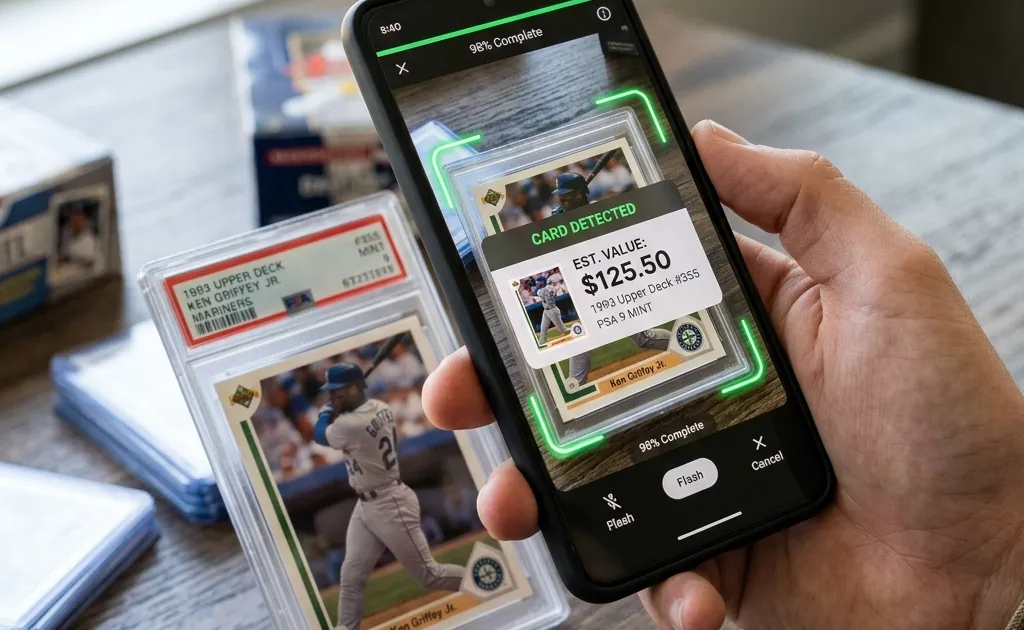
A sports card scanner can shorten the work of identifying cards, but the best app depends on what you want to do after the scan. Some collectors need a simple baseball, basketball, or football card identifier. Others want a collection tracker, marketplace, broad trading-card-game support, or deeper historical sales research.
This comparison covers four widely available options: Sports Card Scanner & Value, Ludex, CollX, and Card Ladder. It focuses on public product information and the practical questions a collector should verify before choosing an app. Product pages and store listings were checked on October 29, 2026; subscription terms and supported catalogues can change.
Editorial disclosure: SportsCardValue publishes this website and the Sports Card Scanner & Value app. That relationship creates an obvious commercial interest, so we identify it clearly and avoid assigning unsupported accuracy or speed scores. Features, prices, and free-tier limits can change; check each current app listing before making a decision. This page was reviewed on October 29, 2026.
Quick comparison
| App | Main use case | Camera scanning | Collection tools | Marketplace features | Access to check |
|---|---|---|---|---|---|
| Sports Card Scanner & Value | Identify baseball, basketball, and football cards, research value, and organize a collection | Yes | Yes | No in-app marketplace | Free download; confirm current feature limits in the store listing |
| Ludex | Scan sports cards and TCG cards, organize them, and prepare listings | Yes | Yes | Listing workflow | Free entry point; confirm current subscription and scan limits |
| CollX | Scan, collect, buy, sell, and trade sports and TCG cards | Yes | Yes | In-app community marketplace | Free entry point; confirm current paid tiers and transaction terms |
| Card Ladder | Research historical sales and manage higher-value collections | Manual search rather than a camera-first workflow | Yes | No collector-to-collector marketplace focus | Limited access plus a Pro tier; confirm current coverage and pricing |
The table is a starting point, not a substitute for testing your own cards. A scanner that performs well on a common flagship base card may behave differently on a low-numbered parallel, obscure regional issue, vintage card, or card photographed through a scratched holder.
Field-verification matrix
Use this matrix when comparing the apps. The descriptions reflect publicly documented workflows; they do not mean every card will be recognized or that a feature is included in every plan. “Verify” is deliberate: confirm it in the current app listing or in the app before importing a collection.
| Question to verify | Sports Card Scanner & Value | Ludex | CollX | Card Ladder |
|---|---|---|---|---|
| Camera-based card identification | Publicly described for sports cards; verify the exact set | Publicly described; verify sport and TCG coverage | Publicly described; verify the card type | Primarily search and sales research rather than a camera-first claim |
| Save cards to a collection | Publicly described; verify current limits | Publicly described; verify plan limits | Publicly described; verify account requirements | Publicly described; verify current plan access |
| See market evidence | Review the displayed comparables and their dates | Confirm whether the displayed value is a sale, estimate, or asking price | Confirm the source and whether a listing is a sale | Historical sales research is the core workflow; verify coverage |
| Sell or create a listing | Not presented as an in-app marketplace | Public listing assistance is described; verify destination and fees | Marketplace workflow is described; verify transaction terms | Not the collector-to-collector marketplace focus |
| Free access | Free download/entry point; verify current limits | Free entry point; verify scans, ads, and subscription terms | Free entry point; verify paid features and terms | Limited access and Pro options; verify current pricing |
A repeatable comparison worksheet
Before choosing, photograph the same six cards in each app and record only observable results. Do not turn one pass into an accuracy percentage. Record the card, the suggested identity, the fields you corrected, the time you spent confirming it, whether the app exposed relevant sales, and whether a paywall appeared. The six-card set should include a modern base card, serial-numbered parallel, vintage card, graded card, foil or glare-prone card, and autograph or relic card. Save screenshots only if the app’s terms and your privacy practices allow it.
| Card test | Identity fields to check | Value evidence to check | Result / correction |
|---|---|---|---|
| Modern base | year, set, card number, team | recent raw sales | |
| Serial-numbered parallel | parallel name, color, serial number | same parallel, not base | |
| Vintage | year, manufacturer, variation | comparable condition | |
| Graded | company, grade, label details | same company and grade | |
| Foil or glare | player and set, image variation | confirm the exact issue | |
| Autograph or relic | authentication, insert/relic type | same card number and variation |
This worksheet is more useful than a winner claim because it exposes the mismatch that matters to your collection. A collector with mostly modern base cards may value a fast confirmation workflow; a vintage or parallel-heavy collection may need more manual verification and stronger sales evidence.
How to choose a sports card scanner app
Use the six-card worksheet above in every app. Keep the photographs and lighting consistent, and record whether the app identifies the following fields correctly:
- player and team;
- release year and manufacturer;
- product or set name;
- card number;
- base card, insert, parallel, autograph, or memorabilia variation;
- grading company and grade, when relevant.
Do not judge an app only by whether it recognizes the player. Two cards can use the same photograph while having very different print runs and market values.
Check how the app handles value
A useful value workflow should let you distinguish:
- completed sales from active asking prices;
- raw cards from professionally graded cards;
- one grading company or grade from another;
- the base card from a refractor, color parallel, variation, autograph, or numbered version;
- recent transactions from older sales that may no longer represent the market.
Treat any single estimated price as a research lead. Open the comparisons, confirm they refer to the same card, and use several relevant sales to establish a range. Our sports card valuation guide explains that process in detail.
Check the free tier before scanning a collection
“Free app” can mean free to download, a limited number of scans, ads, restricted history, or optional paid features. Before importing hundreds of cards, verify current limits, export options, cancellation terms, and whether your collection remains usable if you stop paying.
Sports Card Scanner & Value
Sports Card Scanner & Value is designed around a simple workflow: photograph a baseball, basketball, or football card, review the suggested identity, research available market information, and save the card to a collection.
It is a practical candidate for collectors focused on those three sports who want identification and collection tracking in the same app. It is not an official appraisal service, and users should verify the card number, variation, condition, and comparable sales before buying or selling.
Consider it when:
- your collection is primarily baseball, basketball, or football;
- you want sport-specific scanning guides and a straightforward collection workflow;
- you are comfortable verifying a suggested match rather than treating it as final.
Check before choosing:
- current scan and collection limits;
- support for your specific years, brands, and unusual sets;
- whether the available market comparisons match your preferred research method.
The app is available from the Apple App Store and Google Play.
Ludex
Ludex presents itself as a scanner for sports cards and trading-card games. Its public site highlights card identification, price information, collection management, listing assistance, and hobby-trend features.
Consider it when:
- you collect both sports cards and TCG products;
- marketplace-listing assistance is important;
- you want hobby-trend features alongside scanning.
Check before choosing: current free-scan allowance, subscription price, supported categories, export options, and whether its value comparisons fit the cards you own.
CollX
CollX combines visual card identification and portfolio tracking with a collector marketplace. Its public product information emphasizes scanning, collection pages, price estimates, and the ability to buy, sell, grade, or trade with other users.
Consider it when:
- community and marketplace functions are central to your workflow;
- you collect sports cards and TCG categories;
- you want public collection or seller features.
Check before choosing: marketplace fees and terms, how price estimates are calculated, free-tier limits, privacy controls, and whether you want collection data tied to a social marketplace.
Card Ladder
Card Ladder is better understood as a price-research and collection platform than a camera-first scanner. Its public price guide emphasizes a large sales database, historical transactions, filters, and paid Pro access.
Consider it when:
- historical sales research matters more than automatic camera identification;
- you collect cards with enough transaction history to justify deeper analysis;
- you want to study individual sales rather than accept one estimated number.
Check before choosing: coverage for your exact cards, free-access limitations, subscription price, and whether a manual-search workflow suits the size of your collection.
Scanner app vs. manual lookup
A scanner is useful for creating a search starting point. Manual lookup remains important when the card is rare, altered, counterfeit-prone, difficult to distinguish from a parallel, or valuable enough that a mistaken match would change a buying or selling decision.
Use this hybrid workflow:
- Scan the card to obtain a suggested identity.
- Verify the year, set, number, and variation on the physical card.
- Search for several recent completed sales of that exact match.
- Compare the same condition or the same grading company and grade.
- Exclude lots, reprints, different parallels, and suspicious outliers.
- Record a reasonable range rather than one exact price.
Which app should you choose?
- Choose Sports Card Scanner & Value if your focus is baseball, basketball, and football identification with collection tracking.
- Test Ludex if you want broader sports/TCG coverage and listing-oriented tools.
- Test CollX if an integrated collector marketplace is important.
- Consider Card Ladder if historical sales research is more important than camera scanning.
Whichever app you choose, test it with representative cards before committing a large collection. Scanner output is most useful when it makes identification and research faster—not when it replaces verification.
Continue with our sports card scanner guide, compare an online scanner with a mobile app, choose a workflow for baseball cards, basketball cards, or football cards, and review how SportsCardValue handles estimates.
Identify and Research Your Sports Cards
Download the Sports Card Scanner & Value app to identify, catalog, and track baseball, basketball, and football cards. Confirm the exact card and condition before relying on an estimate.